

What software engineering already figured out
Continuous integration means every change gets merged and tested constantly. Continuous deployment means working changes ship without a big-bang release. Together, CI/CD turned shipping software from an event into a habit.
AI needs a third C: continuous improvement. Every time a model drafts an email, routes a ticket, or matches an invoice, the result either worked or a person fixed it. That fix is the most valuable data your company produces about AI, and almost nobody captures it.
Continuous improvement means recording what the AI got wrong, comparing its output to what actually happened, and putting that lesson in front of the next run automatically. Without that loop, month six looks like day one. With it, the system gets better at your company specifically, which is the one thing you can't buy off the shelf.
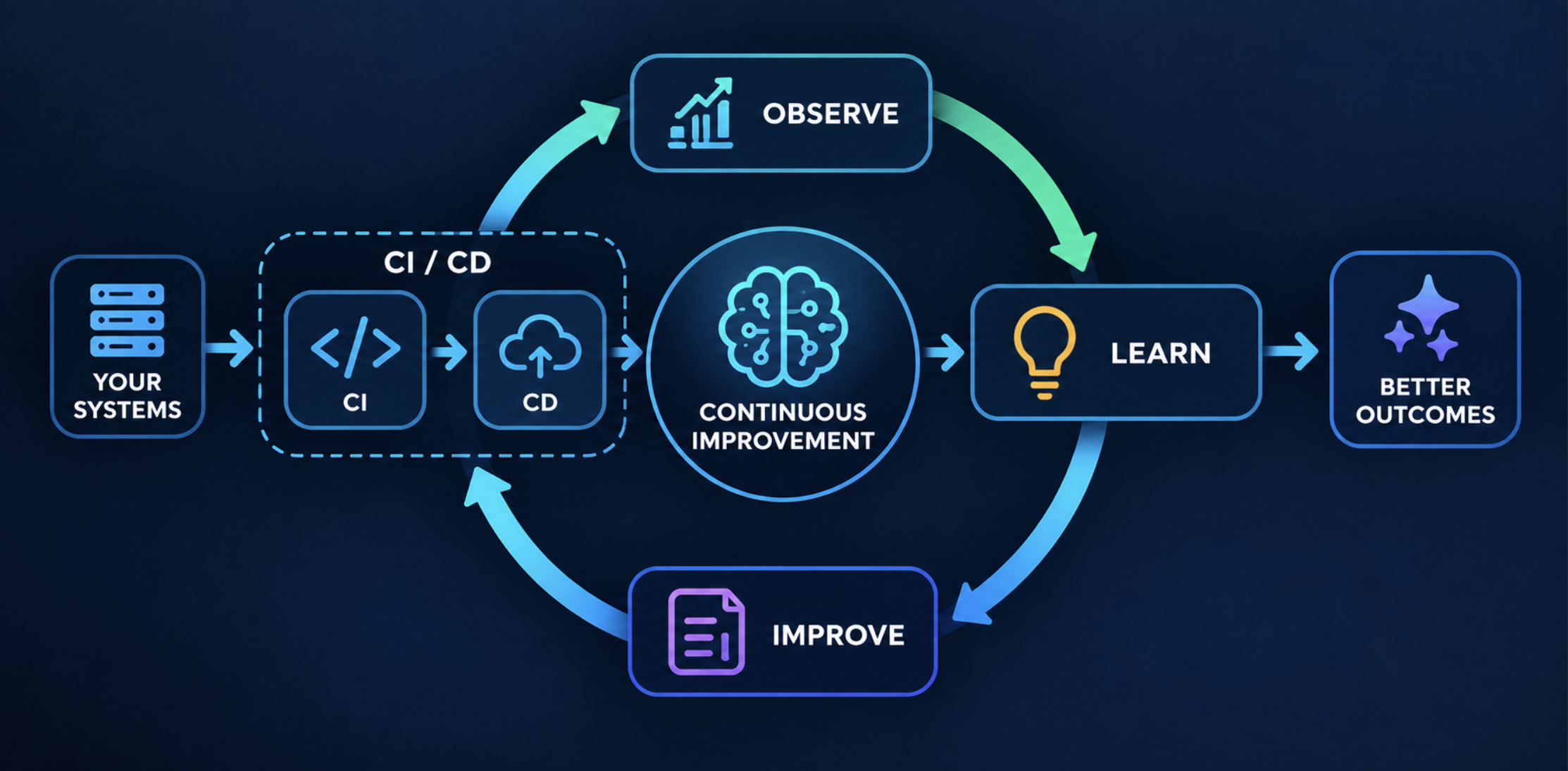
The real problem isn't adoption
Most companies don't have an AI adoption problem. They have a continuous-improvement problem.
They buy the tools. People use them. Six months later the AI makes the same mistakes it made on day one, because nothing in the company is set up to make it learn. Every correction an employee makes disappears the moment they move on to the next task.
Software engineering solved this problem years ago, and the fix carries over almost directly.
The research says the same thing
MIT's NANDA initiative studied 300 public AI deployments in 2025, along with 150 interviews and a survey of 350 employees. About 5% of generative AI pilots produced rapid revenue growth. The rest stalled.
The researchers didn't blame the models. They blamed a learning gap: generic tools stall inside companies because they don't learn from or adapt to how the company actually works. That's the missing third C, described from the outside.
They also found more than half of generative AI budgets going to sales and marketing tools, while the biggest returns came from back-office automation. Companies start with the flashiest tool in the most visible department. The returns are in the boring workflows nobody wants to map.
Memory is not improvement
I learned this distinction firsthand. I run about a dozen AI sessions at once across several businesses, and the expensive part was never switching between them. It was re-explaining where I was, every time, because each tool's memory stayed locked inside that tool.
So I built a shared memory: plain text files that every AI tool I use reads before it answers and writes to when something changes. It fixed the re-explaining. It didn't fix the mistakes. My tools now remember what I told them, but none of them notice when their output was wrong, and none of them get better because of it.
Memory keeps context. Improvement compares what the AI produced to what actually happened, turns the gap into a lesson, and feeds that lesson into the next prompt. Plenty of companies buying "AI with memory" think they're getting the second thing. They're getting the first.
The loop starts with a map
You can't build a feedback loop around a workflow you haven't mapped. Mid-sized companies, roughly 50 to 500 people, run on workflows that grew one hire at a time. Information lives in the CRM, the ERP, three spreadsheets, and somebody's inbox. Before you pick a tool, answer three questions:
- Where does the same information live in more than one place? Every duplicate is a place someone retypes data, and a place it drifts out of sync.
- Where is copying between systems someone's actual job? That's the cheapest automation you'll ever find.
- What could your current team run on Monday without hiring anyone? A roadmap your team can't operate is a document, not a plan.
Then check what people tell you against what the systems show. They rarely match, and the gap is usually where the time goes.
Where to start this quarter
- Pick one back-office workflow with real volume. Invoice matching, ticket routing, onboarding paperwork, vendor reconciliation.
- Map it end to end. Every system it touches, every hand-off, every place someone retypes something.
- Automate one step, not the whole thing. Choose the step your team can supervise.
- Log every correction. A shared doc is fine to start: what the AI got wrong, and what the right answer was.
- Feed the log back in weekly through prompts, instructions, or the vendor's settings. Then track the correction rate. It should fall.
If the correction rate isn't falling, you don't have an AI problem. You have a loop problem, and that's fixable.
The question was never which AI tool to buy. It's which workflow you'll learn from first.
Sources
- MIT report: 95% of generative AI pilots at companies are failing, Fortune, Aug 18 2025, reporting MIT NANDA's "The GenAI Divide: State of AI in Business 2025"