

People search "Reddit alternative" for two different reasons, and the lists that rank for it usually only answer one.
The first reason is a grudge. The 2023 API pricing change killed Apollo, Reddit Is Fun, and Sync, more than 8,000 subreddits went dark in protest, and in 2024 the opt-out for personalized ads quietly disappeared. If that is why you are here, almost any list will do. Pick a site, make an account, complain in a new place.
The second reason is newer. Reddit is closing the door behind you, and it is not clear the people already inside are people.
The door is closing
For twenty years the thing that made Reddit different from Facebook was that you did not need an account. You searched a question, you landed on a thread, you read the answer, you left. No signup, no email, no app.
That is ending, in pieces, fast.
On June 30, 2026, a Reddit admin posting for the Community Safety team announced that old.reddit.com would require everyone to log in, rolling out over the following month. The stated reason was that the logged-out version of the legacy site is a significant source of abusive scraping and automated traffic. Old Reddit ships clean server-rendered HTML with no JavaScript and no cookies required, which makes it the easiest machine-readable surface Reddit still had exposed.
In May 2026, Reddit tested an unskippable "get the app to keep using Reddit" prompt on mobile web, aimed at frequent logged-out visitors. Not the old nagware banner with a "continue in browser" escape hatch. A wall.
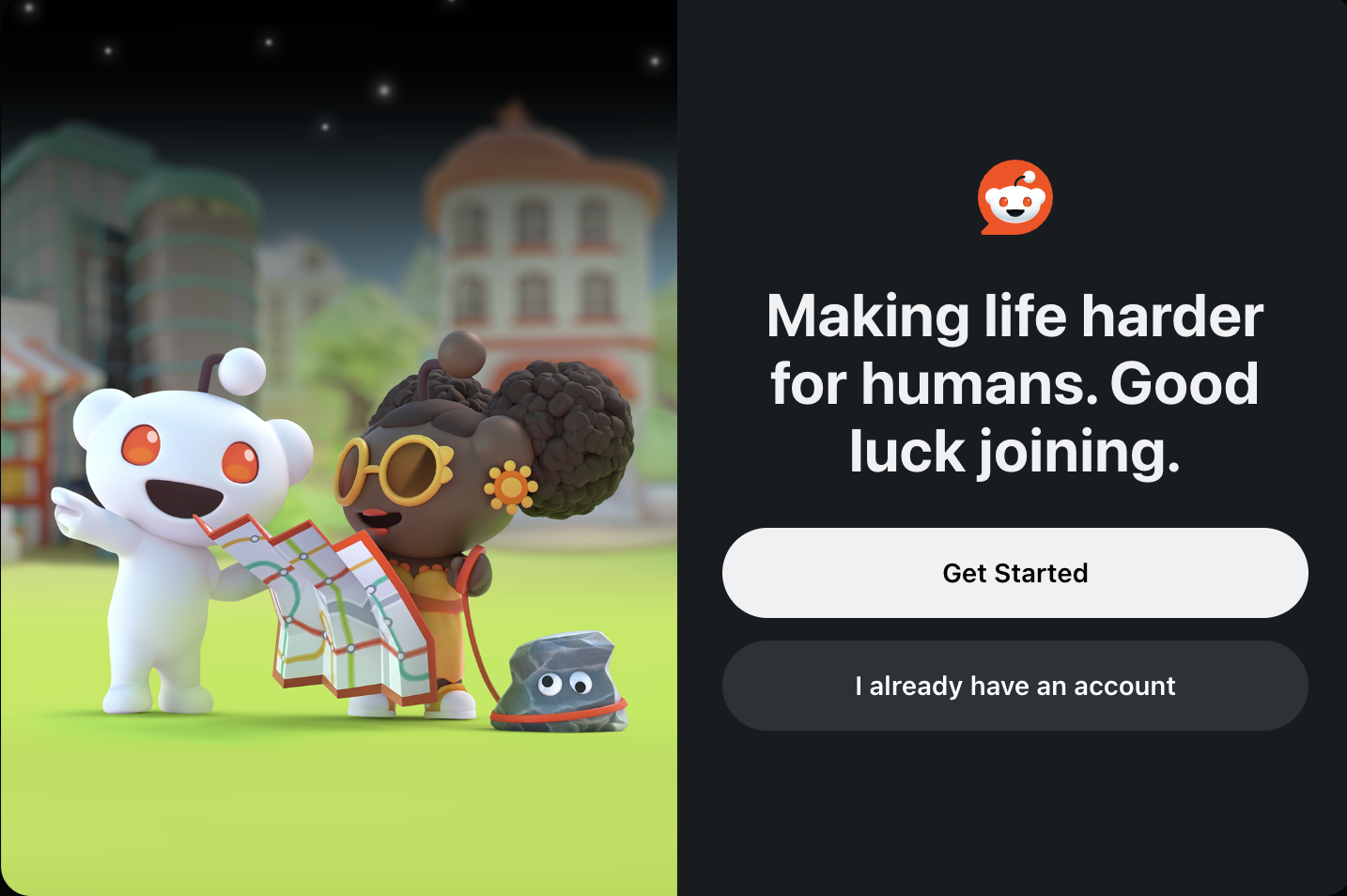
And through August 2026, users have been reporting that new desktop Reddit now throws a login modal after two or three clicks, with two options: "Get Started" or "I already have an account." No dismiss. Reddit has not announced this one as policy, so treat it as a test rather than a finished decision, but it is being reported widely enough that it is not a handful of people with weird cookies.
Meanwhile the price of joining went up quietly. For most of Reddit's life the signup form asked for an email and let you skip it. The field was there, it was optional, and you could leave it blank and finish creating the account. Guides written as recently as this spring still told privacy-minded users to do exactly that. Try it now and the skip is gone. Email is mandatory.
That change never got an announcement, which is what makes it worth noticing. The login walls came with admin posts and a stated rationale. This one just shipped.
Layer it together and the picture is clear. Reddit is converting from a public archive you could read into a private database you have to join, and joining now costs a real contact address. Every request then carries an account ID, which is exactly what the anti-scraping argument requires and also exactly what an ad business wants. Both things are true at once. The anti-scraping motive is real and the ad-targeting benefit is a real windfall, and nobody has to be lying for both to be the case.
Why this matters more than the moderation complaints
The old complaints about Reddit were about how it treats members. This one is about whether you are allowed to be a non-member.
A huge share of Reddit's value to the wider internet came from people who never had accounts. You searched "why is my dishwasher leaking" and got a thread from 2019 where a stranger solved it. That was Reddit functioning as public infrastructure, and it is what earned Reddit its position in search results.
Login walls do not just annoy those visitors. They change what Reddit is. A forum you must join to read is a forum, not a reference.
The other half of the problem
Reddit is also not confident that the people inside are human.
On March 25, 2026, the company announced it would begin requiring accounts that trip bot-like signals to verify a person is behind them, using passkeys, biometric services, third-party providers like World ID, or government ID where local law forces it. Steve Huffman framed the aim as confirming a person exists, not learning who they are. Approved automated accounts started carrying an APP label at the end of that month.
That is a reasonable policy and also an admission. You do not build a personhood check unless you have lost confidence that your users are persons.
The numbers behind it are not small. Reddit removes roughly 100,000 spam and bot accounts a day. Originality.ai's sampling put likely AI-generated Reddit posts at about 13 percent in 2024 and around 15 percent a year later. Cornell Tech researchers found the number of subreddits with explicit rules about AI use more than doubled between July 2023 and November 2024, meaning moderators felt this long before the company acted.
Worth being precise about the limit of that check. It targets accounts that behave like software. It does not target humans who use AI to write, which is still permitted at the site level. So the system answers "is someone home" and leaves "did a person actually think this" to individual subreddits.
Put the two policies side by side and you get the shape of 2026 Reddit. Harder to get in as a reader, and once in, still no strong signal about who wrote what you are reading.
Why most Reddit alternatives fail
Search the term and you get twenty lists. Check the links and the picture changes.
kbin.social is offline. SaidIt has been down since the start of 2026 and is not accepting accounts. Both still appear on lists published this year, which means a meaningful share of "best Reddit alternative" content is routing people to ghost towns.
Then there is Digg, which is the whole argument in one story. It relaunched in January 2026 as a Reddit-style community platform with real money and real attention behind it. It shut down again in March, roughly two months later, overwhelmed by SEO bot spam. Not out-competed by Reddit. Not abandoned by users. Drowned.
That is the actual failure mode for a new Reddit alternative in 2026. You do not lose to the incumbent. You lose to whoever is generating text at scale, because a growing open forum is a free distribution channel and it will be treated as one within weeks of getting noticed.
The live options are real, with trade-offs nobody puts in the headline.
Lemmy and Mbin are federated and genuinely open source. Lemmy had roughly 455 instances and close to 48,000 monthly active users in late 2025: a functioning community, and a rounding error next to Reddit. Federation also asks you to pick a server before you have any basis for picking one, and moderation quality varies by whoever runs it.
Discuit skips federation and keeps the familiar shape. Smaller, calmer, no ads.
Tildes deliberately suppresses the mechanics that make Reddit addictive. Fewer votes, less algorithmic pull, longer comments. People who want thoughtful discussion love it. People who want the dopamine hit leave in a day.
Discord gets listed constantly and does not belong. Real-time chat with no durable public archive is a different product, not a Reddit replacement.
4chan solves the ads and moderation complaints by removing moderation. Different problem, not fewer problems.
The four questions worth asking
If you are actually going to move, these determine whether you are still there in six months.
Is anyone home right now? Not registered accounts, which every platform inflates. Open the newest posts. Are there comments, from this week, that read like someone meant them?
What is the density? Thirty people posting weekly is a place. Five thousand dormant accounts is an archive with a login screen.
What does it cost to get in, and what does that cost buy? Open registration means you arrive instantly and so does everyone with a content calendar. Any barrier is friction, and friction is only worth it if it removes something you actually wanted removed. A mandatory email address buys the platform a marketing channel and a recovery hook. It buys you nothing, because a bot operator has more addresses than you do.
What happens when it gets noticed? Digg is the test case. Ask what a platform does the week an SEO operator decides it is worth farming. If the answer is "our moderators will handle it," the answer is no.
Doors, not features
The structural question in 2026 is not which site has better dark mode. It is when a platform checks, and what the check is for.
Reddit is now doing both kinds of gate at once, and they point in opposite directions. The login wall checks you at the door and asks for an email, which stops scrapers and builds an ad profile but says nothing at all about whether you are a person. The humanity check happens after the fact, on suspicion, triggered by behavior, and fires after the content is already written and read. One gate collects identity without establishing personhood. The other establishes personhood without collecting identity. Neither is checking the thing most people actually want checked, which is whether a human being was on the other end of the sentence they just read.
The alternative approach is making entry itself the verification, where somebody already inside stakes something on you being real. That is slower by design, it will never produce Reddit's numbers, and it fails obviously if the people vouching are careless. It also means the question got answered before anything was written rather than after.
Neither is free. A gate costs you growth. An open door costs you certainty. And a gate that collects your email while telling you nothing about who you are talking to costs you both.
That is the real filter for anyone shopping for a Reddit alternative right now. Not features. Not a nicer feed. Ask what a site is willing to give up, ask what its front door is actually checking for, and ask whether it is checking for the thing you came here to escape.
Richard is the founder of Chirpper, a social platform where every account traces back to a human who vouched for it.